Expensive Thoughts
On aesthetic words, linguistic relativity, the Blub Paradox, and the private languages of the internet

This week I want to put my linguistic hat on and think about language. More from Sociolinguistics than computational linguistics. There are some words that become noticeably weaker when translated to other languages. The translation preserves enough of the outline to appear successful while leaving behind the reason anyone needed the word in the first place. I was reading a few old poems by different people from Delhi when I came across Daagh Dehlvi’s poem:
Khatir se ya lihaaz se main maan to gaya, Jhuthi qasam se aap ka iman to gaya.
Apart from being informative, these poems have been in my mind for the general language used. Complicated meanings expressed in 3 syllables are very interesting. For example let us think about lihaaz (لِحاظ), an Urdu/Hindi word that dictionaries place somewhere among attention, regard, consideration, respect, deference, relation, and even shame.[1] None of those translations is exactly wrong, which is what makes them frustrating in my eye. To have lihaaz for someone is not merely to admire them privately or decide that they deserve your respect. It is to allow their presence, their vulnerability, their age, or their particular relationship to you to alter your conduct. You lower your voice because an elder is in the room. You do not expose someone’s embarrassment because affection has given them a claim upon your restraint. You may be furious with a person and still behave with lihaaz, because the word does not only describe what you feel about them; it describes the point at which their existence enters your decision-making. English can obviously express this (I have just expressed it in English, so you obviously can). But it took several sentences to do what lihaaz can do in two syllables, and that difference is more important than the usual claim that something has been “lost in translation.”
Sapir Said What to Whorf?!?!
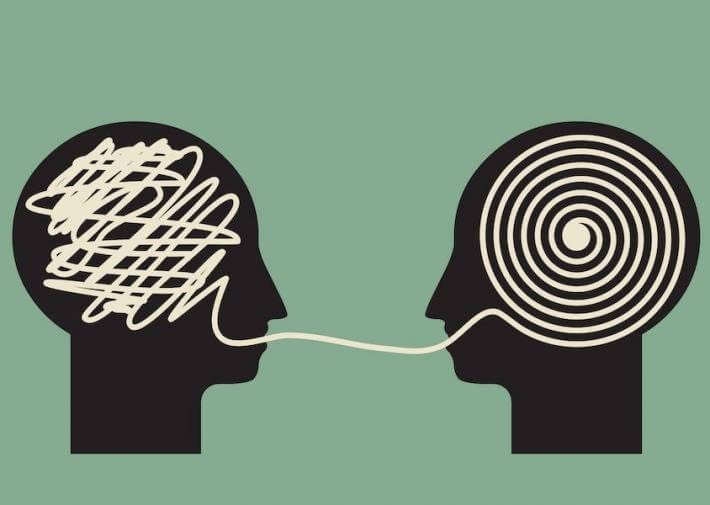
The obvious historical name hovering over this question is the Sapir-Whorf Hypothesis, although the label makes the intellectual history sound tidier than it was. Sapir and Whorf did not jointly formulate one clean hypothesis; the name now covers several claims about language and thought.[2] At its strongest, linguistic determinism says that language fixes the limits of what its speakers can think. I do not find that version convincing, nor do I need it. The weaker claim, usually called linguistic relativity, is that the distinctions a language repeatedly asks its speakers to make can influence what they habitually notice, remember, categorize, and express. This is close to what Dan Slobin called “thinking for speaking”: the rapid process by which we shape experience into the forms our language makes readily available.[3] I do not think words such as lihaaz contain mystical emotions inaccessible to outsiders, nor do I think an English speaker is incapable of arriving at the same thought. The distinction I care about is not between a thought you can have and a thought you cannot have. It is between a thought that arrives already compressed and one you must build manually each time. The version of Sapir–Whorf I find persuasive is therefore less a theory of mental imprisonment than a theory of cognitive pricing. Human speech moves quickly: lexical access begins within a few hundred milliseconds, and ordinary speakers produce several words each second while coordinating conceptual, grammatical, phonological, and physical machinery.[4] We do not normally have time to compose an anthropology lecture before responding to a guest, an insult, or somebody else’s embarrassment. Language has to hand us a usable thought while the moment is still occurring. A familiar word is not necessarily truer than a paragraph, but it is cheaper to retrieve, easier to communicate, and more likely to become habitual. Research on processing fluency suggests that ease is not psychologically neutral: information that is easier to process can feel more familiar and, under some conditions, more credible.[5] Language does not need to prohibit a thought in order to reduce its influence. It only needs to make that thought slightly more cumbersome than its competitors.
But what is a Blub?
Paul Graham’s Blub Paradox talks about a concrete metaphor for understanding how abstractions shape what we are able to perceive. In his 2001 essay “Beating the Averages,” Graham asks us to imagine a programming language of average expressive power and call it Blub.[6] A programmer who uses Blub can look down the hierarchy of programming languages without much difficulty. When she encounters a language that lacks a feature she uses every day, its weakness is immediately visible. She can point to the missing abstraction and explain exactly why programming without it would be tedious. Perhaps the weaker language lacks lexical scope, first-class functions, pattern matching, automatic memory management, or some other facility that Blub has made ordinary for her. Looking downward is easy because every missing feature corresponds to an inconvenience she already knows how to name. She can imagine being deprived of one of her tools because she currently possesses that tool. The absence is legible to her.
Conversely when the Blub programmer looks upward, i.e. a more expressive language does not necessarily appear more expressive from where she stands. Its unfamiliar facilities may look ornamental, excessively abstract, or like complicated alternative syntax for things Blub can already accomplish. The programmer sees the new language through the categories Blub has given her, so she translates every unfamiliar construction back into its nearest Blub equivalent and then reasonably asks what all the fuss is about. If someone shows her a powerful macro system, she may see an elaborate way to perform textual substitution. If someone shows her higher-order functions, she may see a needlessly indirect method of calling ordinary functions. If someone shows her algebraic data types and exhaustive pattern matching, she may see a verbose arrangement of classes, flags, and conditional statements. She can reproduce the visible result in Blub, and because she can reproduce it, she concludes that nothing important is missing. What she cannot easily perceive is that the other language has changed the unit in which the problem is represented. It has not merely shortened an existing Blub solution. It has made a different solution natural.
That is the paradox: the programmer can clearly identify the limitations of languages beneath her but cannot reliably identify the limitations of her own, because those limitations determine the vocabulary with which she evaluates alternatives. A feature that would expose Blub’s weakness is also a feature Blub has not taught her to think with. Read beside Sapir–Whorf, the Blub Paradox looks like a computational parable of linguistic relativity. Blub does not make higher-order abstractions unthinkable, just as English does not make lihaaz inaccessible. It changes which representations arrive naturally and which must be reconstructed. Graham’s claim is deliberately provocative, and his ranking of languages can be debated (I would urge people who work in CS to check it out; the man had some hot takes), but the perceptual asymmetry he identifies is useful. Programming languages are not interchangeable bags of punctuation. They supply abstractions, and abstractions affect what programmers notice, which distinctions they preserve, where they expect complexity to live, and which solutions feel idiomatic rather than perverse. Matthias Felleisen made a related point more formally when he argued that comparing languages only by the functions they can compute is largely useless because most general-purpose languages are already computationally universal. The meaningful differences lie in what structures can be expressed directly, what must be reconstructed through elaborate translations, and how much of the original program’s organization survives that reconstruction.[7]
This is why “they are all Turing-complete” is such an unsatisfying response to arguments about programming-language power. Turing completeness concerns what can be computed in principle, given a suitable model and effectively unlimited patience and memory. Programmers care about what can be written, understood, changed, tested, and kept alive by other human beings. A language can theoretically permit a solution while making the solution so sprawling and unnatural that no reasonable person will choose it. Conversely, an abstraction can turn a pattern that once required hundreds of lines of delicate machinery into a small, named object that programmers can manipulate without repeatedly reopening its internals. The abstraction does not necessarily create a new mathematical possibility. It changes the cost structure of the work. It makes one path short enough to become ordinary, and once that path becomes ordinary, programmers begin finding uses for it that they would never have searched for when every use required rebuilding the road.
A musician offers a simpler way of understanding what I want conveyed. A novice listener may know that modulation, counterpoint, syncopation, or harmonic patterns exist. She may have read a definition, watched someone explain it at a piano, and even learned to reproduce the relevant sequence of notes. Yet the music will not necessarily arrive in her mind through those categories. What she lacks is the accumulated experience that makes a structure perceptually native: the years of hearing it recur, vary, disappear, and return until it stops being an idea she consciously applies and becomes part of what the music immediately sounds like. Before learning harmony, a chord change may register as little more than one pleasing collection of notes replacing another; afterwards, the listener hears departure, instability, expectation, and return. Before developing a sense of rhythm, syncopation may sound like a note placed strangely or even incorrectly; afterwards, she feels the silent beat that the note resists, anticipates, or delays. Two listeners may therefore hear exactly the same performance while noticing different objects within it. One hears a melody accompanied by chords; the other hears voices moving against one another, a tonal centre being established and undermined, a beat withheld for several measures before finally resolving. The expert has not gained access to sounds that were physically absent from the novice’s experience, just as the more expressive programmer has not gained access to computations that were mathematically impossible in Blub. What has changed is the level at which the experience becomes intelligible. A structure that once had to be reconstructed through explanation now presents itself directly, before conscious translation begins. This is the deeper power of an abstraction: it does not merely give us a new label for something we already perceived in full. It trains attention (I used a cheap callback to my first blog, but also I usually naturally write and then search for such patterns so I will allow it in this instance) until a pattern that was previously buried inside the experience moves closer to its surface.
This is also the more defensible way to talk about natural language and thought, and the version of Sapir–Whorf worth keeping. Saying that an English speaker cannot understand lihaaz would be absurd; saying that an English speaker may not habitually organize social restraint around precisely that compact category is far more plausible. Translatability answers the same limited question that Turing completeness answers. Yes, a sufficiently patient English speaker can explain the concept. Yes, a sufficiently patient programmer can simulate one language’s features in another. But the important question is not merely whether a translation exists. It is what the translation costs, how much scaffolding it introduces, whether it preserves the original structure, and whether anyone will actually use it when thinking at ordinary speed. Linguistic relativity is most convincing not as a claim that grammar erects walls around consciousness, but as a claim that repeated linguistic habits train attention. Slobin’s “thinking for speaking” framework suggests that speaking requires us to attend to the features our language routinely asks us to encode.[3] When those features are ready at hand, we practice noticing them. When they require an improvised detour, we may still notice them, but less automatically. A language need not dictate a worldview in order to tilt one.
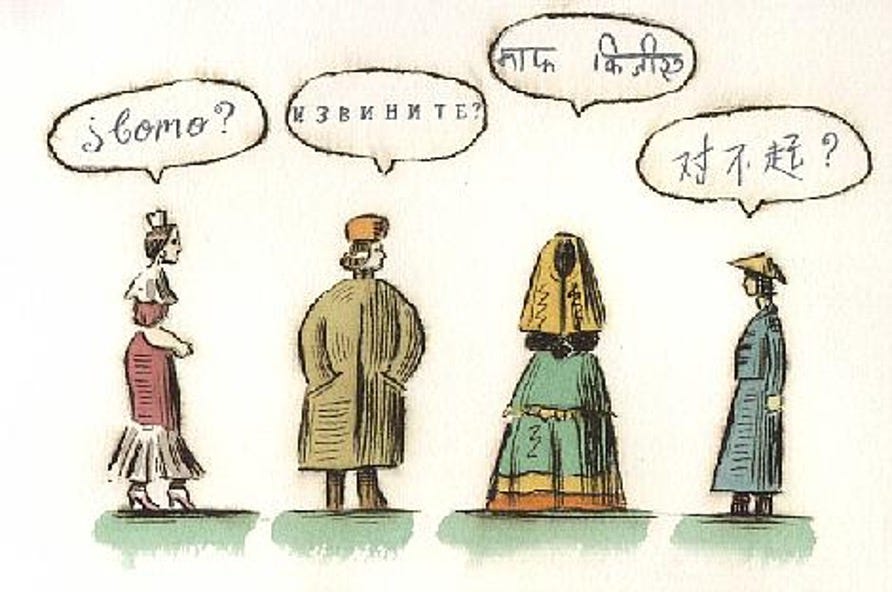
Seen this way, learning another language resembles moving up Graham’s power curve, although there is no single hierarchy with one language sitting triumphantly at the top. Each language makes some distinctions remarkably cheap and leaves others scattered across circumlocutions, context, tone, or silence. The monolingual person encounters an unfamiliar word and often treats it as an ornate foreign synonym for something already known: lihaaz (لِحاظ) is respect, amae (甘え) is dependence, aṟam (அறம்) is virtue, and inyeon (인연) is fate or connection (watch past lives, thats all I will say on this one). This is the natural Blub reaction. The unfamiliar concept is rendered into the nearest available category, and because the rendering is intelligible, the translation appears complete. But the value of the foreign word may be precisely that it divides the conceptual terrain differently. It groups together situations your language taught you to keep separate, or separates experiences your language placed under one vague heading. Learning it does not unlock an emotion no other human has ever felt. It gives you a handle, and having a handle affects whether you can pick something up quickly enough to use it.
Internet & memes are fairly eloquent
The internet offers a particularly vivid demonstration because it manufactures handles at extraordinary speed. Expressions such as “touch grass,” “let him cook,” “main-character energy,” “NPC,” and “copium” are funny partly because they compress complicated judgments into portable forms. “Touch grass” does not literally recommend contact with a lawn. It diagnoses a person as having spent so long inside an online symbolic environment that ordinary embodied life is being prescribed as corrective evidence. “Let him cook” asks an audience to suspend judgment because a sequence that currently appears strange may resolve into something impressive. Calling someone an “NPC” does more than call them unintelligent; it borrows the architecture of a video game and suggests that some people possess meaningful interiority while others merely repeat scripts written elsewhere (writing about the meaning of each of these words has truly made me respect each word. Never thought meme language words would be so eloquent). These expressions are tiny theories of human behavior. Once learned, they make particular interpretations available almost instantly, much as a programming abstraction allows a programmer to invoke an entire mechanism by name rather than rebuild it instruction by instruction.

Image memes do something similar through reusable structure. Researchers have described meme templates as “expressive repertoires” that both enable and constrain what users can say: the shared image supplies a relationship among roles, emotions, or events, while each new caption fills those roles with local material.[8] The distracted-boyfriend template, for example, already contains attraction, betrayal, neglected obligation, and the ridiculous transparency of desire before anyone labels its three figures. A user does not have to narrate that structure because the template has made it common property. Other work analyzing millions of Reddit memes has found socially meaningful differences in how communities use, innovate upon, and acclimatize to meme forms, with patterns resembling variation in written language[9] (brain rot memes seem to verbalize the current climate compared to the Vine era). Understanding a meme therefore means more than recognizing the objects in the image. It means possessing the correct decompressor. You need to know which earlier uses are being recalled, what tone the template normally carries, whether the current use is sincere or ironic, and how far the new caption departs from the expected pattern. To use the meme correctly is to demonstrate that you share a piece of the community’s conceptual machinery.
Your humor is inherently polictical
This gives us a richer way to understand internet echo chambers. An echo chamber, as described in the last post, is usually described as a place where people encounter the same claims repeatedly and have their existing beliefs reinforced. While true, repetition is only part of the process. An echo chamber is also a community in which the cost of expressing familiar ideas keeps falling. In that sense, online communities create small, fast-moving versions of linguistic relativity: they invent a vocabulary, reward its fluent use, and train members to sort events through the distinctions embedded in it. Shared premises stop needing explanation (think about the “Matt Damon getting saved” meme, or the “You Guys Are Getting Paid?” meme). Explanations become slogans, slogans become acronyms, acronyms become images, and eventually an entire historical story, moral judgment, and theory of power can be summoned with one phrase. This is not strong Sapir–Whorf; joining a subreddit does not make rival thoughts impossible. It is relativity at the level of habit. Some interpretations become immediate and socially rewarded while others feel awkward or suspicious. Research on misinformation discussions has found stronger group-identity signalling and greater processing fluency inside echo chambers, suggesting that their language becomes especially easy for insiders to recognize and navigate.[10] Studies of community-specific language on Reddit have likewise shown that online groups develop distinctive linguistic signatures and that users may reduce their use of this in-group vocabulary when the community itself is disrupted.[11] The language is not merely reporting membership after the fact. It helps maintain the experience of membership.
Inside such a community, communication can feel extraordinarily lucid. Everyone appears to understand what matters, which events connect, who can be trusted, and what a particular example proves (in the die-hard KATSEYE community, for example, there is this well-known “fact” that one of the group members has become addicted to drugs; there has never been any iota of proof to logically prove this, but that does not seem to matter to people). Much of this efficiency comes from the fact that the group is no longer transmitting its premises; it is transmitting compressed references to premises already held in common. Outside the community, the same language can sound hysterical, evasive, cruel, or completely meaningless because the listener lacks the archive required to expand it. A phrase such as “do your own research” may function in one group as a declaration of intellectual independence and in another as evidence that the speaker has abandoned standards of proof. “Safety” may mean protection from physical danger, institutional exclusion, psychological distress, state coercion, reputational attack, or unwanted speech, depending on the community using it. People may seem to be disagreeing over whether safety is important when they have actually compressed different models of danger into the same word.
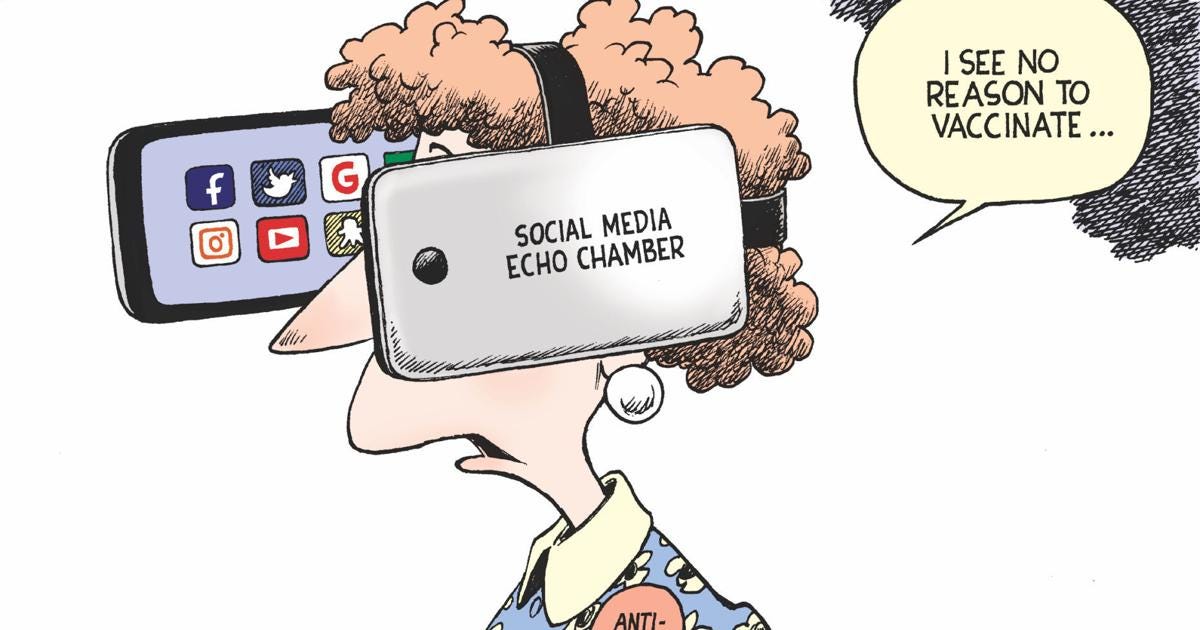
Every echo chamber eventually becomes a kind of Blub. Its members can look downward, or outward, at groups whose concepts they already understand and identify their errors with ease. Looking upward or sideways is harder because a rival community’s conceptual machinery often presents itself as an unnecessary complication of reality. The insider translates every unfamiliar distinction into the nearest category provided by their own group and then concludes that the rival distinction is dishonest, delusional, or merely semantic. A different account of policing becomes “hating law and order.” A different account of gender becomes “denying biology.” A different account of speech becomes either “supporting censorship” or “defending abuse.” The translation may not be wholly invented, just as the Blub programmer’s reconstruction of a higher-level feature is not wholly incorrect. It is damaging because it removes the structure that made the other position intelligible on its own terms.
The most consequential effect of an echo chamber may therefore not be that it makes opposing information unavailable. The opposing information is often visible everywhere. The deeper effect is that it changes the price of interpreting it generously. Your own side’s argument arrives pre-compressed into familiar words, shared examples, moral intuitions, and jokes that have been repeated until their conclusions feel almost perceptual. The opposing argument arrives in a dialect associated with stupidity, danger, or betrayal. Understanding it requires slowing down, translating its vocabulary, recovering its hidden premises, distinguishing its strongest version from the caricature circulating in your group, and temporarily resisting the social reward attached to contempt. Dismissing it may cost one meme. Understanding it may cost an afternoon. Research on processing fluency helps explain why this imbalance matters: people often use ease as a cue when evaluating familiarity and truth, so the position that moves smoothly through a community’s established language may feel more self-evident even before its evidence has been examined.[5][10]
Meme language intensifies this because a meme can move arguments across community boundaries without carrying their full genealogy. Studies of meme diffusion have documented how forms originating or thriving in fringe communities can travel into larger platforms and mainstream spaces.[12] During that journey, an ideological concept may become an ironic joke, the joke may become a flexible template, and the template may later reintroduce parts of the original worldview to people who have no idea where it came from. The meaning is not preserved intact, but neither is it erased. It survives as a posture, a hierarchy, a way of dividing people into winners and losers, protagonists and NPCs, those who “get it” and those who do not. Meme language can be inventive, intimate, and genuinely clarifying; it can give people names for experiences that formal language has ignored. It can also smuggle assumptions past the moment when we might otherwise stop to examine them. Compression removes friction, and friction is sometimes the only thing that gives judgment time to arrive.
At the same time that internet communities are generating thousands of private dialects, the technical infrastructure of the internet is pushing in the opposite direction. Translation between low-resource language pairs often relies on high-resource pivot languages because direct parallel data are scarce, meaning that one language can become an intermediate structure through which two others must pass.[13] Large-scale research into web data has also found that machine-generated translations make up a substantial share of translated material in lower-resource languages and, in some cases, a concerning fraction of the total web content found in those languages; the translated material was disproportionately associated with low-quality English content distributed widely across many languages.[14] The internet is therefore producing a peculiar combination: conceptual standardization underneath and tribal specialization on top. More of the world is routed through a small number of dominant technical and linguistic systems, while communities living on those systems develop increasingly compressed local languages that outsiders can read but cannot fully decompress. We are given the same platforms, the same interfaces, and often the same words, yet we carry incompatible archives into them.
But why learn new languages and experience different cultures
This is why, in researching for this blog, I no longer think the most interesting thing about lihaaz is that it is beautiful or supposedly untranslatable. Beauty is easy to admire without allowing it to change anything. The more serious issue is that when lihaaz becomes “respect,” the instruction contained in the word becomes less immediate. The thought remains possible, but its price rises. This is the modest Sapir-Whorf claim running through the essay: language need not determine the contents of the mind to reorganize its defaults. Something similar happens whenever a community loses a useful distinction, whenever an idea survives only as a paragraph no one has time to recite, and whenever we translate another group’s conceptual vocabulary into the bluntest categories of our own. The opposite occurs whenever a new word, joke, metaphor, or programming abstraction gives us a handle for something we had repeatedly encountered but never quite managed to hold. Language does not decide absolutely what we can and cannot think. It decides which thoughts are waiting near the surface, which ones arrive in time to affect our behavior, and which remain theoretically available while becoming expensive enough that we almost never bother to have them.
The honest reason to learn another language, then, is not to collect charming foreign words and arrange them as evidence that other cultures are deeper than our own. It is to discover that the categories which feel natural to us are not nature. They are tools we have become so accustomed to using that we no longer feel them in our hands. The Blub programmer does not escape Blub merely by being told that more expressive languages exist; she has to use another language long enough for unfamiliar abstractions to become ordinary and for old problems to begin presenting themselves in new shapes. We probably do not escape our linguistic and political Blubs through exposure alone either. We have to spend enough time inside another vocabulary to understand what work its distinctions are doing before translating them back into ours. That does not mean accepting every foreign concept or rival ideology as true. It means delaying the translation long enough to notice what it would erase. A thought does not have to be forbidden to vanish from a culture or a person’s life. It can simply become a little more expensive each year, until one day we realize that although we still possess all the words required to explain it, we no longer reach for it when it matters.
- Sacchin “I spent way too long researching for this article” Sundar
Authors Notes:
Another new blog on linguistics say whaaa. But on a real thought I wish I had studied linguistics. The amount of interesting research happening on pattern detections in this field is crazy. It feels super refereshing to learn about a concept and see it being applied in real time. Also shout out J for the word references on this one, you a legend. I do not really have a lot to say this week but do not fret I will be back soon with another overly researched article on something that has no tangible value. Side note I just finished reading “The repeat room” by Jesse Ball and was blasting flipturn while writing this. Highly recommend both.
References
[1] Rekhta Dictionary, “Lihaaz,” meaning.
[2] Zlatev, J. and Blomberg, J., 2015. Language may indeed influence thought. Frontiers in psychology, 6, p.149534.
[3] Slobin, D.I., 1987, September. Thinking for speaking. In Annual Meeting of the Berkeley Linguistics Society (pp. 435-445).
[4] Strijkers, K. and Costa, A., 2011. Riding the lexical speedway: A critical review on the time course of lexical selection in speech production. Frontiers in psychology, 2, p.356.
[5] Reber, R. and Unkelbach, C., 2010. The epistemic status of processing fluency as source for judgments of truth. Review of Philosophy and Psychology, 1 (4), 563–581 [online]
[6] Graham, P., 2005. Beating the averages.
[7] Felleisen, M., 1991. On the expressive power of programming languages. Science of computer programming, 17(1-3), pp.35-75.
[8] Nissenbaum, A. and Shifman, L., 2018. Meme templates as expressive repertoires in a globalizing world: A cross-linguistic study. Journal of Computer-Mediated Communication, 23(5), pp.294-310.
[9] Zhou, N., Jurgens, D. and Bamman, D., 2024, June. Social meme-ing: Measuring linguistic variation in memes. In Proceedings of the 2024 Conference of the North American Chapter of the Association for Computational Linguistics: Human Language Technologies (Volume 1: Long Papers) (pp. 3005-3024).
[10] Wang, X., Li, J. and Rajtmajer, S., 2024, May. Inside the echo chamber: Linguistic underpinnings of misinformation on Twitter. In Proceedings of the 16th ACM Web Science Conference (pp. 31-41).
[11] Trujillo, M., Rosenblatt, S., De Anda-Jáuregui, G., Moog, E., Samson, B.P.V., Hébert-Dufresne, L. and Roth, A.M., 2021, August. When the echo chamber shatters: Examining the use of community-specific language post-subreddit ban. In Proceedings of the 5th Workshop on Online Abuse and Harms (WOAH 2021) (pp. 164-178).
[12] Zannettou, S., Caulfield, T., Blackburn, J., De Cristofaro, E., Sirivianos, M., Stringhini, G. and Suarez-Tangil, G., 2018, October. On the origins of memes by means of fringe web communities. In Proceedings of the internet measurement conference 2018 (pp. 188-202).
[13] Elmadani, K.N. and Buys, J., 2024, May. Neural machine translation between low-resource languages with synthetic pivoting. In Proceedings of the 2024 Joint International Conference on Computational Linguistics, Language Resources and Evaluation (LREC-COLING 2024) (pp. 12144-12158).
[14] Thompson, B., Dhaliwal, M., Frisch, P., Domhan, T. and Federico, M., 2024, August. A shocking amount of the web is machine translated: Insights from multi-way parallelism. In Findings of the Association for Computational Linguistics: ACL 2024 (pp. 1763-1775).
the idea of thoughts having a “cost” really stayed with me. i’d never thought about language this way before. not as limiting what we can think, but making some thoughts easier to reach than others. this was such a rabbit hole in the best way lol
This reminds me of the time I was first explained the difference between prepositions used in english and in spanish. In english we say "I dream of someone" but the spanish to english translation of a similar sentence would be "I dream with someone". The language we use allows us and also binds us to perceive the world in different ways and I really found that interesting.